Thursday, 30 April 2009

Joe Tilson: Political Prints

While some Pop artists have ploughed the same furrow since the late 1950s, others have restlessly dug up new ground in pursuit of more personal visions. Joe Tilson is one such artist.
     Initially lauded as founding figure of Pop, he grew tired of its relentless consumerism. At one point, he drew up a list of things you shouldn't do in print making and ticked them off, one by one. By the mid-1970s he was spending more and more time in Italy, turning his hand to reliefs inspired by Greek and Roman mythology. 
     The Printed Works 1963-2009 shows how throughout all these artistic upheavals, he has cultivated a formidable reputation as a subversive printmaker, one who has remained engaged and fascinated by the modern world, no matter which part of it he was living in. 
     Chiming with the protesting spirit of the 1960s, revolutionary politics looms large in his earlier work. Is This Che Guevara? (pictured right) features the much-reproduced face of the Cuban leader while Jan Palach commemorates the student who set himself on fire in protest at the Soviet-led invasion of Czechoslovakia. Above all, it is his ability to take these events and turn them into striking, accessible and thoughtful images that makes this exhibition well worth a visit.
     Joe Tilson: The Printed Works 1963-2009 is at Alan Cristea, London, until May 30.

Friday, 24 April 2009

Richard Hamilton: Spring Can Be A Festive Season


Richard Hamilton, I'm Dreaming of a Black Christmas, 1971
Courtesy of the artist and Sims Reed Gallery

Tuesday, 21 April 2009

Into The Sunset: The Definitive Article

Garry Winogrand, New Mexico, 1957

While I was on holiday in New York last week I saw the MoMA's new photography show, Into The Sunset: Photography's Image of the American West. The exhibition has been criticised for being downbeat, delusional or distorted, but that all smacks of a point missed.
     The title is clever in that it never professes to show the real American West, simply what subsequent generations have made of it through the artificial eye of their viewfinder. The scope is broad, covering the last 150 years, though it really comes alive around the 1940s and '50s. Not only do we see the West evolving before our eyes during this period, but also we can witness the rapid development of photography as a unique artistic authority. While the art world busied itself with the luminous ambiguities of Abstract Expressionism and the commercial frivolities of Pop, photography offered a very definitive take on the real world.   
     Like the new sheriff in town determined to clean up the joint, you may not have agreed with the views of these photographers perhaps, but there was no escaping the clarity and intensity of their delivery. Into the Sunset features the best of the period, with classic images from Garry Winogrand, Robert Frank and Lee Friedlander, alongside more experimental images like William A. Garnett's 1950 series of housing developments shot from the air. It tends towards the male perspective but this isn't a humourless or boorish show. End on the glum persistence of Elliott Erwitt's slot machine playing grandma and you'll be grinning until the cow(boy)s come home.

Thursday, 2 April 2009

Georgia O'Keeffe: Skyscraping


I'm going to stay in New York for the Easter holidays and while I was looking at a guide book I was reminded of Georgia O'Keeffe's stylish 1920s cityscapes. She was perhaps best known for her flower paintings or her erotic relationship with the photographer Alfred Stieglitz that played out across two decades worth of their collective art, but this series of sorts captured the skyscraping promise of a city on the rise. 

Saturday, 21 March 2009

Paris: The Jazz Century

I'm currently researching a piece about jazz in Paris for a travel magazine and in doing so I came across a great new exhibition. 
   Le Siècle du Jazz, or The Jazz Century, opened this week and features a host of 20th century art, design and memorabilia. They've got Matisse paintings, bebop-inspired illustrations and all manner of photographs from the era, not to mention sound recordings, a programme of concerts and beautiful vintage album covers. I'll give a more comprehensive update once I make it over to see it, but in the meantime the promise of more than 1,000 works, you can't go far wrong. Le Siècle du Jazz runs at the Musée du Quai Branly until 28 June. 


Tuesday, 10 March 2009

Pablo Picasso: A Little Mad

London appears to have gone a little mad for old Picasso these last few weeks. First came the National Gallery's new show, Challenging the Past. Curated thematically and packed with his riffs on the Old Masters, it's an impressive collection, albeit let down by the dim-lit surrounds of the Sainsbury Wing basement. However it does offer the chance to see his sprawling take on Velazquez's Las Meninas up close, as well as a number of unusual early self portraits.
     If you do get chance to visit, don't miss out on the print collection that they are showing in Room 1 of the main building either. It's free and offers fifteen extra variations on existing works, taking on Degas, Rembrandt and Cranach with a more voyeuristic outlook.
     Albemarle Street dealer's Connaught Brown are also getting in on the printing act with a collection of minor linocuts and etchings; all blood red femmes, deep cut lines and one thing on his mind. 
     Perhaps most excitingly is The Allure of Language, a new Yale Uni publication that I got my hands on this week. It picks up on how fiction, poetry and philosophy fed into Pablo's early Cubist experiments and blossomed into a life-long fascination with the power of words and images combined. Below are two pages he illustrated for Pierre Reverdy's 1948 book of poems, Le Chant des Morts, or "The Song of the Dead", which are reproduced in the new book.


Monday, 2 March 2009

Ray Johnson: Unpopular Pop

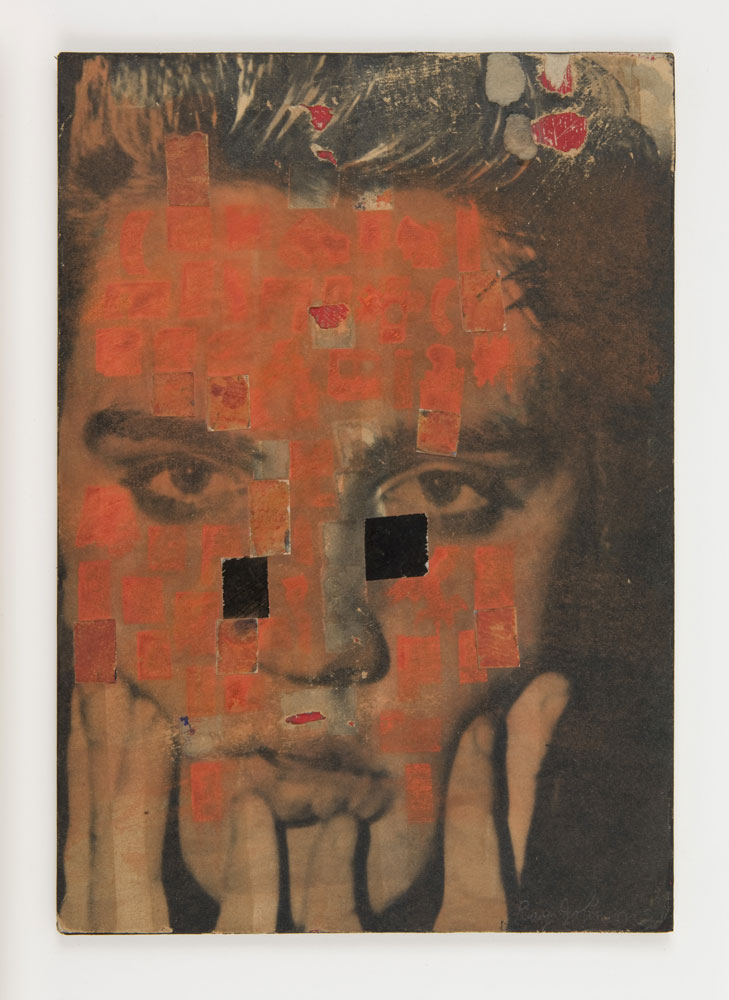
New York artist Ray Johnson (1927-1995) might have relied upon popular culture imagery, yet on this side of the Atlantic at least, his work remains largely unknown. However, a retrospective of his work, Please Add To & Return, opened on Saturday at new East London gallery Raven Row and should hopefully introduce him to a new audience. 
     Johnson graduated from Carolina's liberal Black Mountain College in 1948, where his contemporaries included Willem de Kooning, Cy Twombly and Robert De Niro Sr - the actor's father and a noted abstract expressionist artist in his own right. On moving to New York the same year, he started producing Pop-style portraits of Marilyn Monroe and Elvis Presley (see the striking Elvis #2, 1956-57, pictured right) almost a decade before Warhol and co. got in on the act.
     During this period, Johnson worked in a bookstore on Manhattan's Lower East Side, where he developed his interest in Zen philosophy and the art of chance. This fed into his art practice, as he took up where Marcel Duchamp left off and began to mail unfinished compositions to his friends, with instructions for them to participate in the creative process and send them on. These instructions would often become part of the works themselves.
     Unfortunately he didn't remain so sociable. On the same day in 1968 that Andy Warhol was shot, Johnson too was mugged and attacked near his home in a separate incident. By all accounts, the experience shook the artist, as he withdrew from city life and became increasingly reclusive, even declining offers to show his work by the early 1990s. It is only now, following his suicide by drowning in 1995 that his work is finally beginning to take its rightful place among the 20th century's most challenging and influential names. A personal archive of unseen works were found at his home after his death, adding to his fascinating legacy.
     Ray Johnson. Please Add To & Return runs until 10 May at Raven Row, 56 Artillery Lane, London E1. Image courtesy of the Estate of Ray Johnson at Richard L. Feigen & Co.

Thursday, 26 February 2009

America Conquers The Brits

Edward Hopper, Night on the El Train, 1918

ALVA's annual statistics were released today, confirming the British Museum as the UK's top visitor attraction, with nearly 6 million visitors in the past year. Perhaps the most surprising contribution to those numbers comes from the 355,000 who visited their temporary show, The American Scene: Prints From Hopper To Pollock. In fact, the Museum has even dubbed it "one of the most popular fine art exhibitions ever held in London." 

It is a stunning primer of early 20th Century American art, from the grim realism of the Ashcan school, via Edward Hopper's romanticised nocturnal scenes, right up to the expressive early works of Jackson Pollock. Countless social, political and artistic influences penetrate the collection, from the Great Depression and the rise of Fascism, to film noir, jazz and underground boxing matches, making it unequivocally a product of the era. 

A new discovery among the number was Martin Lewis, whose Little Penthouse and Spring Night, Greenwich Village (below) offer cute visions of life on the streets of 1930s New York, lit by the incidental light from nearby buildings. Thankfully, the exhibition isn't done yet either. The American Scene is currently on tour, taking in Nottingham, Brighton and Manchester over the coming year. 

Martin Lewis, Spring Night, Greenwich Village, 1931

Friday, 20 February 2009

Le Corbusier: Cubist Art and No Buildings

With exhibitions about architecture, you always get the sense that there is an elephant in the room that no one will mention. Or rather, there should be several massive elephants in the room but they couldn't be moved from their natural habitat and they wouldn't have fit in the gallery anyway. In other words, where are the finished buildings? 

Sure, there are many practical reasons why this is a no brainer but there is no other arts discipline in which you would see the workings out but not the final answer. Could you a fashion house holding a retrospective without a single dress on display? Or a sculpture exhibition based on nothing but sketches and maquettes? You can't help feeling that architecture is at a serious disadvantage in gallery terms.

The Barbican's new Le Corbusier exhibition, The Art Of Architecture, steps around the elephant by filling their two floors with the Swiss architect's many other artistic pursuits: pre-Ikea leather-and-steel-tube furniture, back issues of his Modernist mag L'Esprit Nouveau, the odd tapestry and a wealth of Cubist-style sculpture and paintings. Of course, this does mean that your enjoyment of the show hinges on whether you can get excited by some deft Picasso-esque murals but it makes for a varied and often unexpected collection. 

And maybe that is the point of exhibitions about architecture - that they can and should only ever be a colourful appendix to the buildings themselves. Having already been lucky enough to explore both Corbusier's Villa Savoye near Paris and the Maison Blanche in his home town of Le Chaux de Fonds, these art works simply helped to signpost his inspirations that bit more vividly.

Femme et coquillage, 1948


Friday, 6 February 2009

Wim Wenders: Lounge Paintings

Wim Wenders, Lounge Painting # 1, Gila Bend, Arizona 
from "Pictures from the Surface of the Earth"

"It took me hours to find somebody
who could open up the lobby
of the old "Stout's" hotel on Main Street in Gila Bend.
It had been closed for years already.
That painting over the Coke machine haunts me ever since.
It's the dream version 
of the perfect beginning 
of a road movie."


As if Wim Wenders' movies weren't achingly beautiful enough, it turns out he takes great photographs too. The German director carries a panoramic camera around with him as he scouts for film locations and selected prints have been collected together in Pictures from the Surface of the Earth.
     There's everything from Buddhist temples to Havana cadillacs, but he really comes to life in the US. If you've seen Paris, Texas, you'll know Wenders has a keen eye for recreating a sort of lost, mythic Americana. The photographs he took across the Southern states zoom in on individual aspects of this, picking out vintage drinks machines and deserted shop fronts like some 35mm Edward Hopper. Ok, it's not strictly mid-20th century, but it sure as hell looks like it.
     Turns out the week I picked up this book, he opens a photography exhibition at Derby Museum and Art Gallery. Once - Still Images of Moving Pictures opens tomorrow and runs until 13 April, featuring his film location shots from around the globe. 

Wim Wenders, Used Book Store In Butte, Montana